
Table of Contents
- Quick Answer
- Key Takeaways
- How Is a Full Arch Priced Compared With Single Implants?
- Which Steps Does the Total Cover?
- What Pushes the Price Up or Down?
- Does Dental Insurance Pay for a Full Arch?
- How Can Patients Spread the Cost?
- What Should a Written Estimate Include?
- Frequently Asked Questions
- Related Reading
- About the Author
The price of a full arch on four implants depends on four decisions, not one flat fee.
How much does All-on-4 cost in Carmichael, CA? The answer is a personalized estimate, because the price depends on what each mouth needs before and after surgery. Every jaw starts from a different place.
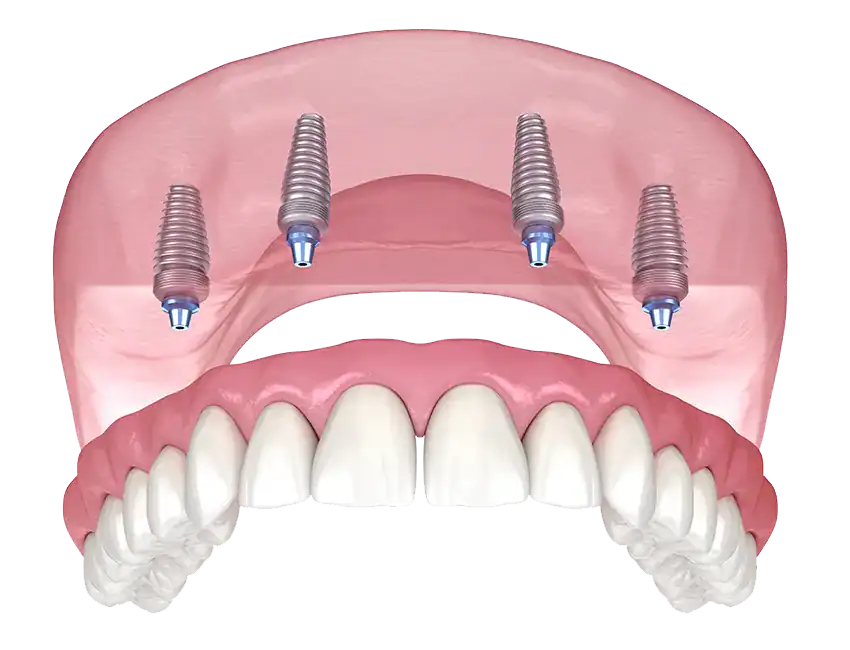
The technique supports a full arch of fixed teeth on four implants rather than one implant for every missing tooth. That design uses fewer implants than a full set of single ones, which can shorten surgery and lower the cost. The final total still moves with four decisions.
Seen one quote and wondered why another practice’s number looks so different? The sections below explain what sits behind each line, so the numbers can be compared fairly.
Quick Answer
The cost of All-on-4 depends on how many arches are treated, whether extractions or grafting are needed, and what material the final teeth use. A dentist gives a personalized estimate after an exam and imaging. Ask for an itemized estimate that lists every stage, from imaging to the final teeth, before treatment begins.
Key Takeaways
- Each arch is priced separately, so treating both jaws means paying for two cases.
- Extractions, bone health and any grafting can add steps before the implants are placed.
- The material of the final teeth changes the fee and how the arch wears over time.
- Insurance rarely pays in full, though some plans contribute toward extractions or replacement teeth.
- A written estimate should list every stage, from imaging to the final teeth, before treatment begins.
How Is a Full Arch Priced Compared With Single Implants?
A full arch on four implants is priced as one case, while single implants are priced around the number of posts. A full mouth of single implants adds up quickly, since each tooth needs its own post and crown.
A full-arch plan uses four posts per jaw and one connected set of teeth, so the fee covers four implants and one set of teeth. According to MouthHealthy from the American Dental Association, dental implants are posts surgically placed in the jaw that act as a sturdy anchor for replacement teeth. When more than one tooth is being replaced, custom-made bridges or dentures are fitted to the implants. The bridge or denture is built for each patient, so it carries its own share of the fee.
Which Steps Does the Total Cover?
The total covers three phases. The same source describes them in order. The implants are placed surgically, the bone heals around them in a process called osseointegration that can take up to several months, and then the replacement teeth are attached. Many All-on-4 patients leave with temporary teeth the same day; Dr. Kovar confirms whether your case allows it. The patient wears the temporary teeth until the permanent ones are ready.
Each phase can carry its own line on an estimate. Imaging comes first, since a 3D scan maps bone volume, nerve position and sinus anatomy before the design begins. Surgery day adds anesthesia, and oral sedation may be offered for a long visit. The temporary teeth and the final teeth follow.
What Pushes the Price Up or Down?
Four decisions account for most of the difference between quotes. The first is how many arches are treated, since an upper and a lower arch are two separate cases. The second is extractions, because teeth that cannot be saved have to come out during surgery.
The third is bone. Angling the back implants reaches bone that is already there, which often spares a patient a separate graft, but a jaw that has shrunk may still need one. The fourth is the material of the final teeth, since the choice changes both the lab cost and the way the arch wears over the years.
Sedation and the temporary teeth appear on the estimate too, so both belong in a comparison of quotes.
Does Dental Insurance Pay for a Full Arch?
Full coverage is rare. Some PPO plans pay toward the extractions or the replacement teeth, and an annual maximum often caps what a plan will pay in a single year. An out-of-network practice may still be able to check what a plan would pay.
The only reliable answer is a written benefits check completed before treatment begins. Until then, any figure for what a plan will contribute is a guess.
How Can Patients Spread the Cost?
Financing is one common way to turn a large fee into monthly installments. Some practices also run in-house membership plans, so it is fair to ask whether a plan’s discount applies to a full-arch case, since a discount may not cover every procedure.
Splitting the work across two stages, such as extractions in one year and the final teeth in the next, can also fit around an insurance maximum when a plan allows it.
What Should a Written Estimate Include?
A useful estimate names the number of arches, the imaging, any extractions, any grafting, the sedation, the temporary teeth and the final teeth, each with its own fee. Without those lines, two quotes may describe different treatments, and the lower figure may simply leave a stage out.
It should also say what happens if a step turns out to be unnecessary, such as a graft that the bone does not require. A written total for the whole case leaves little room for surprises midway through treatment. It gives a patient something to compare line by line.
Frequently Asked Questions
Will I leave with teeth on the day of surgery?
Many All-on-4 patients leave with temporary teeth the same day; Dr. Kovar confirms whether your case allows it. That depends on bone quality and stability at placement, and he explains it before surgery day.
How is All-on-4 different from dentures?
A denture rests on the gum ridge and comes out, while an All-on-4 arch is secured to implants and stays in the mouth. The fixed arch also transfers chewing force into bone, which helps preserve the ridge instead of letting it shrink over time.
How do I clean an All-on-4 arch?
A water flosser and a threader clear the space between the arch and the gum, which matters most for keeping the implants healthy. Regular hygiene visits include cleaning around the implants and checking the fit of the teeth, so home care and office care work together.
Related Reading
About the Author
This post was reviewed by Dr. Dylan Kovar, a trained implantologist who has completed live surgical continuing-education courses in implant placement and surgical extractions, with a focus on restorative, surgical and prosthodontic care. He is a member of the American Dental Association, California Dental Association and Sacramento District Dental Society.
- If you want to learn more about full-arch pricing, visit our All-on-4 Dental Implants in Carmichael, CA, page or schedule a consultation.